Chokepoints
The biggest ‘TACO’ ever


Audio file
In brief
• TACO – “Trump Always Chickens Out”: the Iran ceasefire is the pattern we have been becoming used to at its largest scale.
• The irreplaceable layer is human, not the model: AI commoditizes explicit knowledge, so the edge moves to the tacit – judgment, relationships, soft skills – which can only be grown, not downloaded.
• The US fiscal path does not close: Social Security is years from benefit cuts, and debt nears 100% of GDP, leaving inflation or yield-curve control – and pushing capital toward hard assets.
• The young have gone YOLO (‘You Only Live Once’): priced out of housing and entry-level work, a generation bets on crypto, meme stocks, and sports books – financial nihilism with a political tail.
A non-nuclear state with a military budget of nearly ten billion dollars appears to have deterred the United States, a nuclear power spending nearly a trillion dollars, from finishing a war it had effectively started. No nuclear bomb was needed; the lever was a strait.
The cheap thing beat the expensive thing because it held a chokepoint the expensive thing could not route around – and found a moment it could not afford to test. While Iran could threaten Hormuz, a nominal force held the world’s energy supply hostage, and an administration facing midterms with oil already high was at the table within weeks. That asymmetry is the signature of the moment, and the same fault line runs under everything worth reading now – markets, geopolitics, the texture of work itself: the line between what can be measured, financed, and copied, and what cannot.
The deal
On 17 June, Trump and Pezeshkian signed a fourteen-point memorandum: a sixty-day ceasefire, free passage through the Strait of Hormuz, the blockade lifted and sanctions on a path to ending, assets unfrozen, and a proposed three-hundred-billion-dollar reconstruction fund. On the nuclear question – the casus belli – almost nothing.
Read plainly, it is an Iranian win: the regime survived, the damaged program persists, and Tehran proved it can shut a chokepoint and be paid to reopen it. Alpine Macro goes further – victory on near-maximalist terms, caused by a loss of nerve under the midterm test. The trading floor has a blunter name for the pattern: TACO – Trump Always Chickens Out – Robert Armstrong’s FT coinage for the 2025 tariff cycle, where a maximal threat met resistance, folded, and taught the market to buy the dip on every escalation. This is probably the greatest TACO of them all – not a tariff walked back but a war, the climbdown priced as the adversary’s victory, and it cuts both ways: bullish for risk now, as the war cools and oil falls, and corrosive later, as adversaries learn to work the lever and allies stop leaning on the threat. The diagnosis of the cause is right; I would hold the verdict lighter. A ceasefire whose every durable clause – sanctions relief, the strait’s future, the fund – is conditional and reversible is a deferral, not a settlement, and the arithmetic that bought it can unwind it after November (if not much earlier… I cannot possibly keep up with the constant headlines).
The deeper frame is economic deterrence, a third category besides the conventional and the nuclear. North Korea, with nothing of economic value, bought the bomb and watched regime-change talk evaporate; Iraq and Libya had value but could neither defend nor weaponize it, and were destroyed; Iran combines resource value, proxy reach, and a chokepoint it can credibly weaponize – deterrence without the bomb. The sting is that the West built the trap itself, weaponizing the financial system through sanctions and outsourcing energy, materials, and manufacturing until it is as exposed to embargo as its targets. The best-positioned beneficiary is China.
Squeezed from both sides
So every American-dependent ally watching Israel being sidelined to close the deal, as Europe and Kyiv were over Ukraine, hedges toward Beijing on Beijing’s terms. The hard evidence is real and at the margin: record CIPS volumes, a digital-renminbi pact across twenty-six institutions, and gold overtaking Treasuries as the largest share of official reserves. The soft evidence is where the narrative outruns the data – Swiss gold to Saudi Arabia up severalfold since 2022, read by some as proof that Riyadh will price oil in renminbi, settled in gold, a story a flow statistic cannot yet carry. None of it is near-term regime change; all of it is a direction.
The dollar is also under pressure from within. Under current law, by 2031, mandatory spending and net interest will exceed federal revenue as a share of GDP; debt has risen from about one-third of GDP in 2000 to nearly 100%; and the Social Security trust fund is only years away from cutting benefits to the level covered by payroll taxes alone. Clive Crook’s bind has no clean exit: the populist right will not touch entitlements, while the populist left would tax only the rich, and neither solution closes the fiscal gap. That leaves the old escape routes: inflation or yield-curve control. The process is ‘gradual, then sudden’ – though for a sovereign borrowing in its own currency, “sudden” does not mean default; it means the moment markets reprice debasement. The case for hard assets depends on the form that adjustment takes: an inflation-driven rise in long yields erodes paper claims and supports gold, while a real rise hurts both gold and equities. Even here, the long end decides; what matters is the composition of the move.
Weather and climate
Cheaper oil is disinflationary, most of all in Europe, where Brent at sixty to seventy takes more than a point off headline inflation – making the ECB’s 11 June hike look like an error and a September move unlikely, while a hawkish Fed will struggle to tighten into falling energy. The cyclical setup reads constructive – pro-growth Washington, the OBBBA (One Big Beautiful Bill Act) impulse still flowing, oil falling – with one honest blemish: tariffs settling near nine-to-eleven percent are a tax on growth and a push on prices, not a tailwind.
The dominant driver is the AI capex cycle, and the constructive view rests on one assumption it assumes rather than tests: that the build-out continues. Three things can break it, on three independent axes – the cost of capital, the durability of demand, and political access – and the debate that fills the tape is only about the first. Supply-side-of-a-top and funding-against-verifiable-demand both reduce to the long end: Google raising equity is a yellow flag, Nvidia issuing cheap debt is the counterpoint; the bear’s kill-criterion is a level on the index, the bull’s is the cost of capital rising before capex guidance comes down. Within that argument, the yield is the climate, and the rest is weather – but the rates obsession forgets the other two axes can become climate of their own.
The new risk in the machine
Those two axes sit on no underwriting model. Demand first – the AI boom is built on the idea that bigger is better. A recent study suggests the opposite may soon be true: small language models running on desktop computers may be able to handle most of the tasks currently performed by large language models. If so, the future of AI is smaller, cheaper, and far less profitable than investors expect.
Then access. Late on a Friday, Anthropic pulled its two most capable models, Fable 5 and Mythos 5, for every user on earth – not by choice. Commerce, citing export controls, barred any foreign national, its own non-citizen staff included, from touching them; unable to filter by passport, the company disabled them outright while Opus 4.8 stayed live. Washington calls it a national-security event; Anthropic says the technique was narrow, surfaced only known bugs, that rivals do the same, and the evidence is merely verbal. The uncomfortable part is how self-inflicted it looks: the order landed two days after the CEO argued the state should be able to block dangerous models, after months of marketing Mythos as close to a munition. “They wrote the legal predicate themselves and called it a brand.”
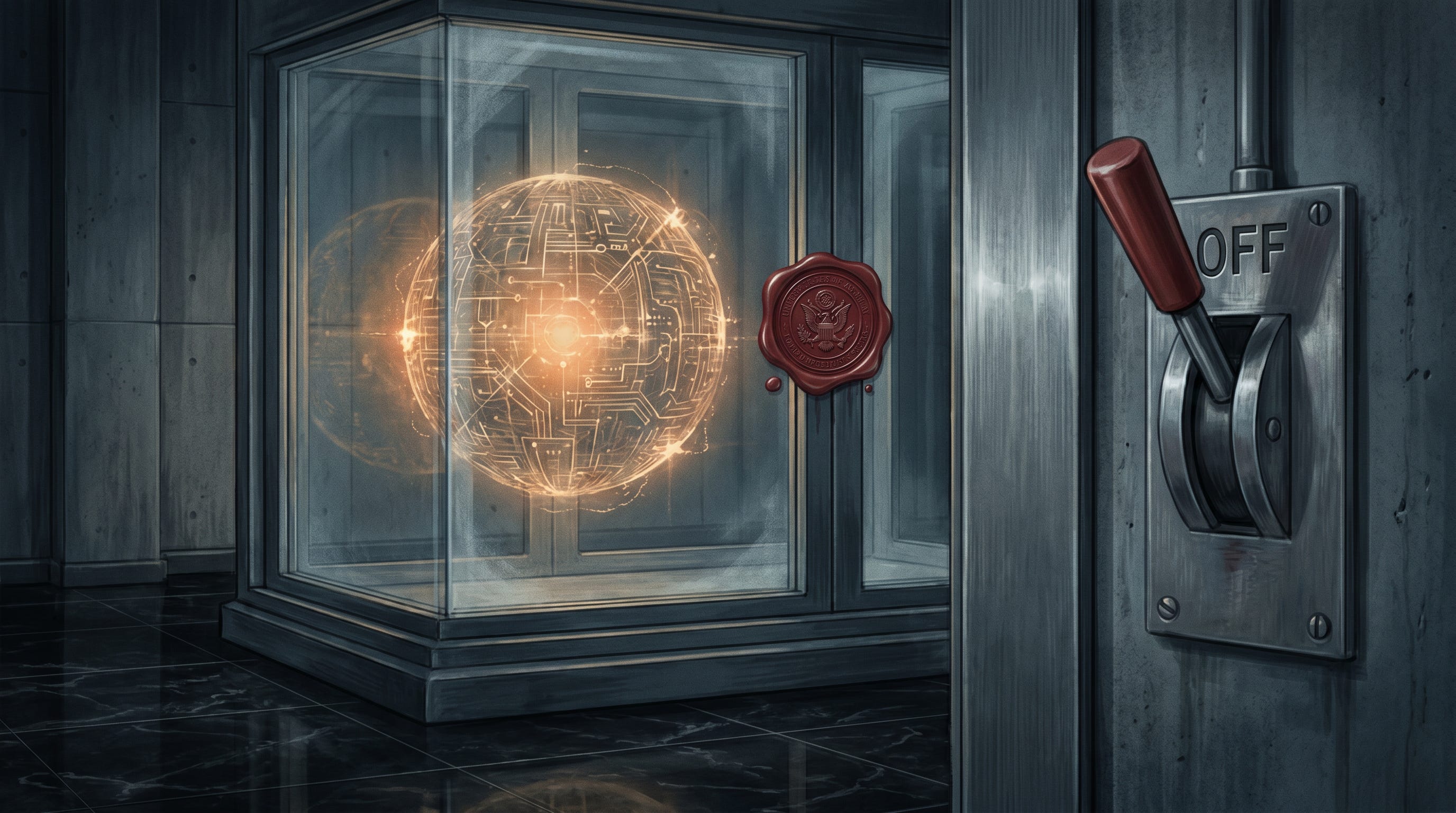
The signal matters more than the incident – a third axis, harder to model than the other two: an administration willing to switch off a frontier model overnight, on contested evidence, mid-IPO. Where access sits and under whose law are no longer footnotes to what the technology can do. It is part of the risk itself.
So, the one thing worth putting in writing: the constructive case is rented, not owned, and the rent is the long end. A ten-year below roughly four and a half percent keeps the build-out – and the multiple – alive; sustained above it, while capex guidance has not yet come down, is what breaks both. It is the single chart I would watch over any headline out of Tehran or Washington.
The treasurer returns
Step back from the tape, and the bigger change is what AI does to a person’s value. For two centuries, knowledge work was split among specialists – designers, engineers, writers – with coordination treated as overhead. AI merges the roles back: one person with a model covers most of what three people did, and the capability that matters shifts from deep specialism to directing the model and integrating the whole. Taylor Pearson’s line is the cleanest: because everyone holds the same tool, the tool distinguishes no one; what differs is what each brings to it. This is Polanyi’s old split – explicit knowledge, which codifies, and tacit knowledge, which does not. The public corpus is explicit; a model trained on it has vast knowledge and no judgment of its own, so the value stays with whoever directs it. The treasurer is making a comeback.
The caveat is the one the cheerful version skips: the boundary between explicit and tacit is not fixed – it is the line AI keeps moving inward. Reading a scan was an expert judgment a decade ago, and then it was codified. So “judgment survives” holds only for judgment that is genuinely non-codifiable, and the honest test is whether the human augments the model or merely narrates it. Jensen Huang secured NVIDIA’s memory from SK Hynix not by algorithm but by relationship – soju, baseball, chicken, and beer – a reminder that the decisions that matter are still made over dinner. Or, as Bezos has it: read a thousand books on gymnastics, and you still cannot do the routine.
And here is the trap the optimistic read never closes. Tacit judgment is not downloaded; it is grown – bottom-up, through years of junior, codifiable work, the model now does best, done beside someone who already has it. If AI eats the bottom of the ladder, no one climbs to the top of it – the thing that survives becomes the thing you can no longer learn. The analyst is becoming impossible to train.
The human face
This is where the macro and the human meet. 13D calls it financial nihilism: around sixty percent of American Gen Z and Millennials now believe the only route to wealth runs through alternatives – crypto, meme stocks, prediction markets, sports betting. The data is brutal – homes near five times median income, eight for the under-thirty-fives, against 3.2 in 1990; flat real graduate wages for three decades; entry-level hiring down by roughly a third – and it is the same lost rung seen from below. The bottom was where skill was grown and where wealth began; remove it and a generation accumulates neither. The tail is political: people who stop believing the economic system rewards them will stop believing the political one represents them. Germany is the same revolt in a European key – two years of contraction, the lowest birth rate on record, US tech now worth more than the entire DAX (the main German Stock Market index), an insurgent right on course to take its first state on a reindustrialization ticket.
Coda
The threads converge on one idea, with a sting. The explicit layer – the data, the consensus, the same model in every hand – is being commoditized at extraordinary speed, and what is left is the tacit layer: judgment, relationships, the work that cannot be codified. That is the comforting half. The sting is that the tacit layer cannot be downloaded, only grown, and we are dismantling the ground it grows in. The cheap force that held the strait, the allocator who leaves early, the dealmaker over dinner, the analyst who can no longer be trained – the same story in different registers. We are commoditizing knowledge faster than we can grow the wisdom to use it – and the treasurer, it turns out, takes a generation to make.
Unlike the leader of the free world, I won't chicken out of the ask – press like. It's the one escalation that hurts nobody.